Falling

Fall /fôl/:
1) Autumn
2) move downward, typically rapidly and freely without control, from a higher to a lower level.
On September 22, 2025, another season will come to an end. Just as quickly as summer entered the scene this past May, we’re now preparing for a new season to arrive on September 23rd: fall.
For some of us, summer wasn’t long enough. Our warm weather vacations, outdoor festivals, and summer holidays moved like a “ship passing in the night,” as Henry Wadsworth Longfellow once wrote. However, whether we are ready for the spotlight to shine on fall’s infinite glory does not matter because God created a universe so organized, and unfazed by our plans, that no matter how we feel a seasonal change is inevitable.
Personally, I’ve always been a fan of autumn for several reasons. One, my birthday, as well as my husband’s birthday, both fall in late September and early October, which means lots of celebrations during both months. Two, I enjoy witnessing the landscape change as the trees go from a vibrant green to hues of orange, red, and yellow. And three, pumpkin spice makes everything “oh, so nice,” especially in a warm-frothy latte.
But one of the reasons I love fall the most is because it is during this season that things take action and “fall” into place. The busyness attached to our summer days finally slows down so we can “fall” into a new routine for this new season. Leaves can even “fall” to fertilize the earth’s soil and prepare us for our next season.
Fall: A short word, yet so complex.
I’d like to illustrate another meaning tied to the word fall. One that no one enjoys experiencing, but when we talk about seasons, we can’t help but discuss action tied to the word “fall,” as that is where change truly lies.
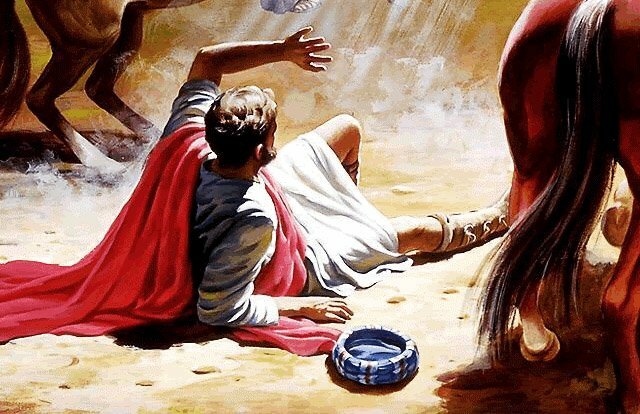
In Acts 9, there was a great fall that led to the conversion of Saul [to Paul]. In Acts 9:1-4, we learn that Saul was continuing to relentlessly persecute anyone who believed in “The Way.” Saul was determined to arrest both men and women who were followers of the Lord, so much so that he asked to be introduced to the synagogues in Damascus, with the hopes of arresting anyone who believed in Jesus and bringing them back to Jerusalem. However, as Saul was nearing the city of Damascus, “a light from the sky flashed round him. He fell to the ground and heard a voice saying to him, “Saul, Saul! Why do you persecute me?” (Acts 9:3).
Mind you, Saul had his own plans. He was on a journey, a path that he believed would fulfill his purpose. Yet, God caused him to fall. And even though Saul was traveling with other men who heard Jesus’ voice, Saul was the only one who fell to the ground. Which means, his fall was attached to his purpose.
Falling.
And even after falling, God told Saul to “Get up and go into the city, where you will be told what you must do.” (Acts 9:6). Imagine that, God knocked him off his feet, just so Saul could rise again, but this time according to God’s plan. Saul had originally created a “man-made” plan to travel to Damascus, but his course was redirected by his fall. When Saul arose off the ground, he discovered he was blind and could not see a thing before him, so the men traveling with him took him by the hand and led him to Damascus.
Have you ever fallen so low that the vision you believed in suddenly disappears? So low that the only way you can continue to believe you once had a vision is by the grace of God calling you to stand on your feet, and walk with true friends who will hold your hand along the way?
Falling.
There’s something so important in the fall — falling not only lets us know that we aren’t in control of our journey, but it gives us insight into who our true friends are. Who was listening to us when we shared our dreams and passions, and who will go the extra mile next to you, even if it wasn’t a part of their plans.
Falling.
Now, there was a believer in Damascus named Ananias (Acts 9:10). He had a vision, where the Lord said to him, “Ananias! Get ready and go to Straight Street, and at the house of Judas ask for a man from Tarsus named Saul. He is praying, and in a vision he has seen a man named Ananias come in and place his hands on him so that he might see again.” (Acts 9: 10-11). Now, Ananias had heard about Saul, and all of the terrible things he had done, but God still called Ananias to “Go” because God had chosen Saul to serve Him. God needed Ananias in order to shift Saul’s season.
Ananias was in a waiting season himself, but God is so amazing that He brought purpose to both Ananias and Saul. From Ananias’ touch, Saul’s vision was restored, and Saul’s original journey to Damascus changed from persecuting Christians to preaching about Jesus.
Had Ananias said, “No” to God out of fear of Saul, we may not be the Christians we are today.
There is deliverance in the fall.
It’s not just a season where temperatures drop and pumpkin becomes the main item on the menu, but a season of falling is when course correction can take place. It’s a season of redirection, and a season of pruning. When the calendar is packed with summer activities, and our minds are focused on the sunny days, we have the potential to miss our mark. It’s no accident that God placed fall immediately after such a sunny season.
He wants us to slow down and fall to our knees in prayer, fall in love with his Word, and remember that his promises will be fulfilled.
As you approach September 23rd, remember there is purpose attached to your next season. God will fulfill every promise to you, even when you go blind to the vision — even when your vision doesn’t align with God’s, He will steer you towards an even better beginning. Trust that He will send an Ananias in your fall, and bring purpose to your next season, no matter the weather, time or place.
But most of all, remember that regardless of the season — God will never leave you.
-
Address